10F, Building B, Erqi Center, Erqi District,
Zhengzhou City,
Henan Province, China
Wit:+86 15138685087
(WhatsApp/Wechat)

10F, Building B, Erqi Center, Erqi District,
Zhengzhou City,
Henan Province, China
Wit:+86 15138685087
(WhatsApp/Wechat)

Let’s start with the conclusion: when it comes to PPGI and PPGL used in PUF panels, neither is “better”; rather, one is simply “more suitable for that specific application.” To determine which is right, you only need to answer three questions: where will the panel be installed? Will the cut edges and openings be exposed for an extended period? And how many years does the panel need to last? Here are two simple examples:
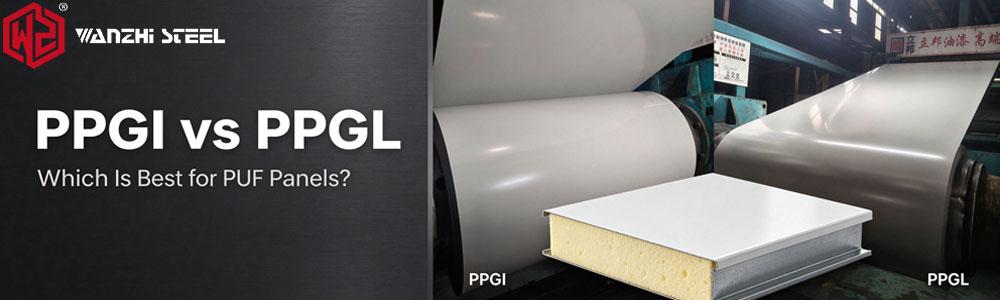
PPGI and PPGL are produced on the same production line—both are manufactured on a color-coated steel production line—and the manufacturing processes are identical; the only difference lies in the substrate, and the most significant difference in the substrate is the coating.
| Item | PPGI | PPGL |
| Substrate | Galvanized steel coil | Galvalume Steel Coil |
| Coating Composition | Zinc ≥99% | Aluminum 55%, Zinc 43.4%, Silicon 1.6% |
| Hot Dipping Temperature | 450–460 ℃ | 590–600 ℃ |
| Coating Weight (Total for Both Sides) | Z30 – Z275g/㎡ | AZ30 – AZ150g/㎡ |
| Rust Prevention Method | Zinc as a sacrificial layer: After the coating is damaged, zinc corrodes preferentially, delaying the rusting of the steel substrate. | Aluminum forms a dense oxide film to isolate corrosive media, resulting in slower overall corrosion; approximately 43% zinc provides auxiliary sacrificial protection at the fracture site. |
| High Temperature Resistance | Coating degradation above 200℃ | Continuous 315℃, short-term, 370℃ |
| Heat Reflection | Approximately 50% (uncoated) | Approximately 75% (uncoated) |
| Material Cost | Lower | 5%–12% higher than PPGI |
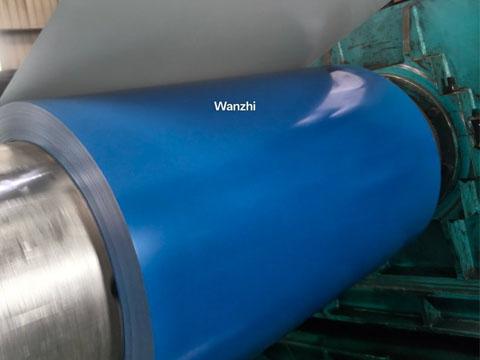
blue ppgi coil

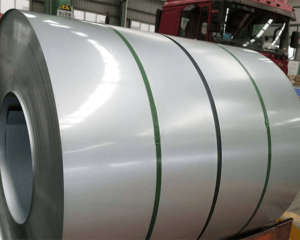
Gray PPGL color coated coil
When selecting between PPGI coils and PPGL coils for PUF metal sheets, the primary consideration is the product’s intended environment and application. Below are our recommended configurations for different environments and applications.
| Applications / Environments | Recommended Specifications | Notes |
| Indoor cold storage wall panels, cleanrooms, temperature-controlled storage facilities | PPGI (Z120–Z180, 20 μm PE on the front, 7–10 μm on the back) | In dry environments with controllable temperature fluctuations, PPGL cannot demonstrate its full advantages. |
| Cold storage ceiling panels, roofs prone to condensation | PPGI or PPGL (Z180–Z275 / AZ150, 25 μm light-colored HDP) | Condensation and flushing are the primary threats. |
| Building exterior walls, roofs (general inland atmospheric conditions) | PPGL (AZ60, 25 μm HDP) | Long service life, low maintenance, and low total cost of ownership. |
| Within 500 meters of the coast, ports, offshore platforms | PPGL (AZ100–AZ150, PVDF 25 μm) | In chloride-ion environments, the coating system and surface treatment are more critical than the substrate. |
| Industrial zones, acid rain areas | PPGL (AZ100–AZ150, PVDF or thick-film HDP) | Sulfur dioxide and acid deposition rapidly deplete zinc. |
| High-temperature workshops, exterior walls near heat sources | PPGL (AZ150, PVDF with higher temperature resistance) | A 315 °C margin is required to withstand radiant heat |
| Aquaculture, fertilizer production, and ammonia-laden environments | PPGI (Z275 with epoxy primer or thick-film coating) | The aluminum-zinc layer degrades rapidly in ammonia environments |
| Direct contact with concrete and mortar | PPGI (Z275, with barrier layer on contact surface) | Alkaline conditions (pH > 9) rapidly deplete aluminum |
| Tight budgets, design life of 10 years or less | PPGI (Z120–Z180, PE 20 μm) | Choose only what is necessary; there is no need to pay for performance features you won’t use |
The choice of metal sheet for PUF panels depends on where the panel will be installed and how many years of protection is required; PPGI is “adequate and inexpensive,” while PPGL is “durable but slightly more expensive.”
We supply PPGI and PPGL color-coated steel coils for PUF panels, We maintain a stock of coating specifications ranging from Z30 to Z275 and AZ730 to AZ150, with base sheet thicknesses from 0.12 to 1.2 mm and widths from 600 to 1250 mm. These are available with PE, SMP, HDPE, and PVDF coatings, and colors can be customized according to the RAL color chart. Please contact us so we can recommend the metal sheet that best suits your needs.